The first leg of our tour takes us to the region Campania and a walk through ancient Roman life. First, we wind our way through Pompeii, one of the most famous archeological sites in the world. This once bustling port city befell catastrophic tragedy when Mt. Vesuvius erupted in 79AD, covering the city in up to 7 meters of ash and pumice and preserving the ancient world as it existed two millennia ago.
Rediscovered in the late 16th century and then excavated in the 17th century, today visitors can explore the baths, private homes, city streets, temples, markets, and amphitheater of ancient Pompeii. Pompeii was so advanced that their public baths had heated running water!
With Pantheon Institute Professors Cothran Ceen and Lavinia Nannini leading the guided walking tours, students learn how ancient urban planning and architectural design has continued to inspire modern day construction and city development. Students spend all day walking through history and sketching the ruins of a civilization lost to nature’s unforgiving intensity.
Next up, we move 65 km north of Pompeii to the city of Paestum. This renowned UNESCO World Heritage site features three of the world’s best-preserved ancient Greek Doric temples. Founded around 600 BC as Poseidonia, it later became a Roman colony (Paestum) in 273 BC. Like Pompeii, the site includes well-preserved Roman infrastructure, including a forum, amphitheater, and 5 km of defensive walls.
The city was abandoned due to malaria and raids in the 9th century, becoming overgrown until its “rediscovery” during the 18th-century and the period of the Grand Tour. It was at this time that scholars began to excavate the park and discovered a variety of artifacts which are now housed in the National Archeological Museum of Paestum. Opened in 1952, the museum’s collection demonstrates human presence in the area for over 40,000 years, the most notable pieces being the Tomb of the Diver marble pieces, fragments of an ancient mausoleum dating back to 480 BC.
Leaving southern Italy behind, we make our way further north to Tuscany and spend two days in the regional capital of Florence. Florence is the cradle of Renaissance architecture, characterized by harmonious proportions, classical symmetry, and iconic, often polychrome marble facades. Key features include the world’s largest brick dome, fortressed palaces, and structures that transitioned from Medieval to Renaissance styles, largely driven by 15th-century architects like Filippo Brunelleschi.
Led by professors Romolo Martemucci and Lavinia Naninni, students tour some of Florence’s most important churches, like the Basilica of Santa Maria Novella, the Basilica of Santa Croce, including the Pazzi Chapel, and the Cathedral of Santa Maria del Fiore, a.k.a. the Duomo, and the Duomo baptistry.
Key lessons from touring Florence include how of the city’s buildings embody the shift away from Gothic verticality toward classical symmetry and balance, with key designers including Brunelleschi, Leon Battista Alberti, and Michelangelo Boromini. Furthermore, the legacy of the Medici family is everywhere as they commissioned many of the city’s most famous structures, solidifying the Renaissance aesthetic and their reputation of one of Italy’s more formidable and powerful familial dynasties.
Leaving Tuscany behind, we enter into the Veneto region and the first of two stops in the final portion of our Academic Field Trip marathon. First up is Verona! Another UNESCO world heritage site, Verona showcases 2,000 years of continuous development, seamlessly blending Roman, Romanesque, Medieval, and Renaissance architecture. The city is characterized by its pink Valpolicella limestone, red brick, and “striped” architectural style.
Our focus in Verona is to visit the Castelvecchio, a 14th-century Scaliger fortress, built between 1354 to 1356, and characterized by red brick Gothic architecture, that features seven towers, a 42-meter Mastio (keep), and a fortified bridge spanning the Adige River. The Castel is now most famous for its landmark restoration by architect Carlo Scarpa between 1957 and 1975. Scarpa blended medieval stone with contemporary materials like concrete, steel, and wood. His masterful renovation, often called “creative destruction,” meticulously separated new, modern interventions from the ancient, historical fabric of the medieval fortress. He introduced innovative display solutions, such as the famous statue of Cangrande I della Scala elevated on a high concrete pedestal.
And last, but certainly not least, our final two days of the tour take place in Venice. Venice is one of the most unique cities in the world, built over 118 small islands and perched upon a foundation of over 10 million of wooden piles submerged in the lagoon. Its architecture features a blend of Byzantine, Gothic, and Renaissance styles, characterized by tall, narrow, and light-filled palaces designed to cope with space limitations, and adorned with Istrian stone to resist saltwater corrosion. The city, built around canals rather than roads, has over 400 bridges, and architecture is heavily influenced by the constant need to manage water, humidity, and, in modern times, sinking.
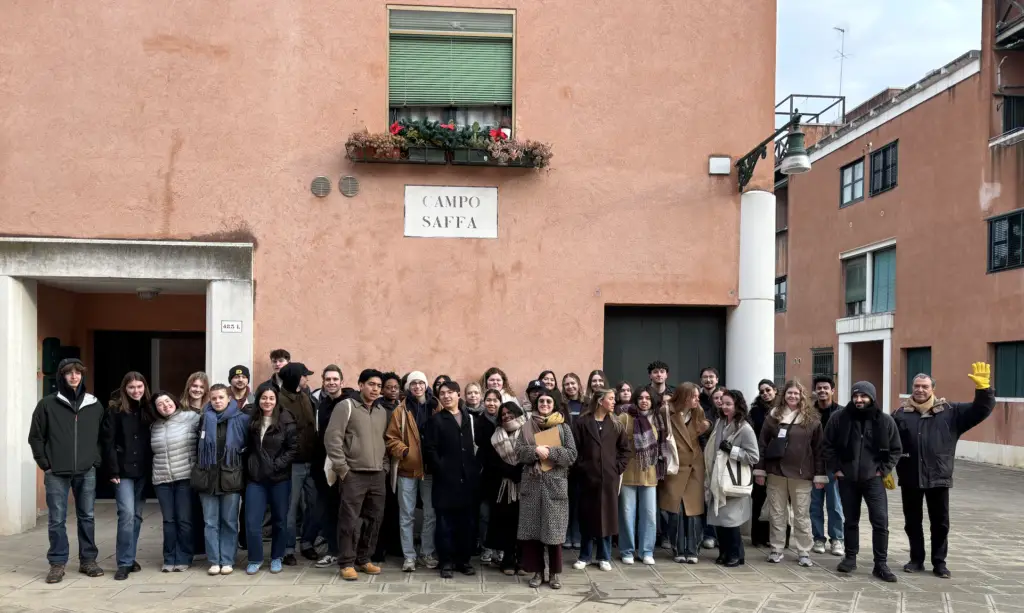
But Venice holds another secret beyond the legendary engineering of its original creation. Hidded in the Cannaregio district, the Ex Saffa housing complex, designed by Gregotti Associati between 1981 and 2001, repurposes a former match factory site to create contemporary social housing. It reinterprets traditional Venetian morphology through modern design, featuring 200 apartments organized around “calli” (alleys) and “campi” (squares), integrating “altane” (rooftop terraces), and utilizing brick, Istrian stone, and concrete.
And that brings us to the end of our Spring 2026 Academic Field Trip series. What a world-wind tour! From ancient Rome to modern public housing developments, Italy is an incredible example of architectural, political, religious, and cultural diversity spanning over 2000 years of human development. We know our students benefit from reflecting on how the past set’s the stage for our present and can inspire us on how to move forward. We will see you all back in Rome. A presto!